The Void Cycle™
Understanding the emotional loops that keep you stuck and how self-trust becomes the key to breaking free.

The Void Cycle™: Why Awareness Alone Doesn't Create Change
Many of the clients I work with arrive in therapy exhausted by a frustrating reality: they have already tried to change. They have read the books, listened to the podcasts, watched the videos, and done the self-reflection. They understand their attachment style, recognize their triggers, and can often explain exactly why they behave the way they do. Yet despite all this awareness, they continue to find themselves in the same relationships, repeating the same patterns, and carrying the same emotional wounds.
Not because they lack willpower.
Not because they lack insight.
But because the pattern they are caught in has never been fully named.
You cannot interrupt what you cannot see.
The Void Cycle™ is a framework I developed to help individuals understand the emotional loops that keep them stuck. Drawing from attachment theory, complex trauma (C-PTSD), somatic psychology, and the Stages of Change Model, it explains why people continue repeating patterns that no longer serve them and offers a pathway toward lasting change. At its core, the Void Cycle™ is not simply about unhealthy behaviors. It is about the relationship we have with ourselves.
Every cycle has a story.
The story becomes a belief.
The belief shapes behavior.
The behavior reinforces the story.
And the cycle continues.
Healing begins in the space between awareness and action.
That gap is where self-trust is built.
The problem is not a lack of awareness. The problem is a lack of self-trust.
Understanding the Void Cycle™
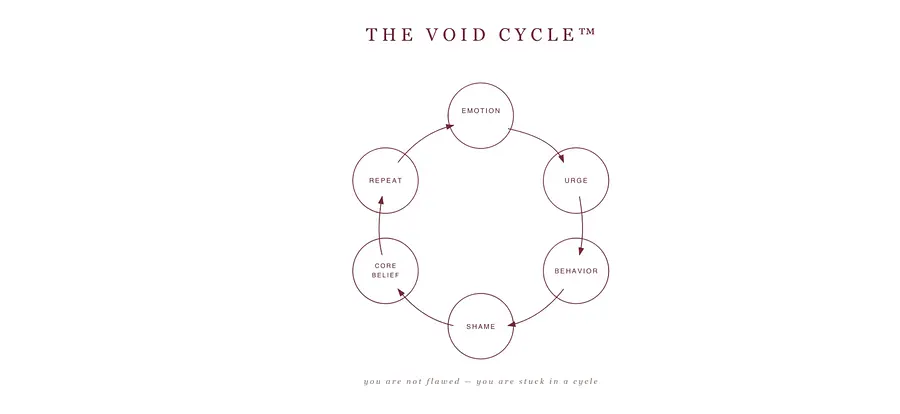
The Void Cycle™ follows a predictable sequence. While the details vary from person to person, the structure remains remarkably consistent.
An emotional wound is activated. Loneliness, rejection, grief, fear of abandonment, shame, worthlessness, or disconnection begins to surface. Although the trigger may occur in the present moment, the emotional intensity is often connected to experiences that were never fully processed. The nervous system responds not only to what is happening now but also to everything that feels familiar about the experience.
As emotional discomfort increases, so does the urge to escape it.
This urge is not random. It is conditioned.
The brain has learned that certain behaviors create temporary relief. For some people, that relief comes through relationships. For others, it may come through overworking, perfectionism, substance use, compulsive caretaking, avoidance, isolation, or constant distraction. Whatever the behavior, the goal is the same: to create distance from emotional pain.
When the behavior works—even temporarily—the cycle is reinforced.
The emotion quiets.
The discomfort subsides.
The void feels filled.
For a moment.
Eventually, however, the relief fades and something else emerges: shame.
This shame is often misunderstood. It is rarely about the behavior itself. Instead, individuals begin using the behavior as evidence that something is wrong with them.
"I should know better."
"Why do I keep doing this?"
"I'll never change."
"I always end up here."
What began as an emotional experience becomes an identity statement.
The shame reinforces the original core belief that was activated at the beginning of the cycle:
I am too much.
I am not enough.
I will always be abandoned.
I cannot trust myself.
I will never be chosen.
The belief generates a new emotional wound, and the cycle begins again.
What makes the Void Cycle™ so persistent is that the behaviors maintaining it are not character flaws.
They are survival strategies.
They were adaptations developed in environments where emotional safety, consistency, or secure attachment may have been unavailable.
At one point, they made sense.
The challenge is that survival strategies that once protected us can eventually prevent us from growing.
The Missing Piece: Self-Trust
One of the greatest misconceptions in healing is the belief that awareness alone creates change.
In reality, awareness is often the easiest part.
Many individuals become incredibly skilled at recognizing patterns while continuing to repeat them.
They know the relationship is unhealthy.
They recognize the red flags.
They feel the discomfort in their body.
They can predict exactly how the situation will end.
And they stay anyway.
This is not a failure of awareness.
It is a breakdown in self-trust.
Awareness tells us what is happening.
Self-trust determines what we do with that information.
Many people have spent years learning to trust explanations over experiences, potential over reality, and promises over patterns. They have become so accustomed to overriding themselves that they no longer recognize when self-abandonment is occurring.
The hardest habit to break is often not the unhealthy relationship, the coping behavior, or the addiction.
It is self-abandonment.
It is knowing what you need and talking yourself out of it.
It is recognizing a boundary and ignoring it.
It is feeling discomfort and convincing yourself that it does not matter.
The Void Cycle™ survives through self-abandonment.
Healing begins with self-trust.
Discernment Is Not Hypervigilance
As individuals begin rebuilding trust in themselves, a new fear often emerges.
"What if I'm just being guarded?"
"What if I'm overthinking?"
"What if this is my trauma talking?"
Many people who have experienced betrayal, inconsistency, abandonment, or emotional harm struggle to distinguish discernment from hypervigilance.
The difference is important.
Hypervigilance scans constantly for danger.
Discernment recognizes patterns.
Hypervigilance assumes everyone will hurt you.
Discernment accepts that some people will.
Hypervigilance is driven by fear.
Discernment is grounded in self-trust.
The goal of healing is not to stop noticing red flags.
The goal is to stop abandoning yourself when you notice them.
Many people remain stuck because they continue searching for more evidence long after clarity has arrived. They believe they need more information before making a decision. Often, they already know what they need to know.
What they lack is confidence in their ability to act on it.
Clarity is peaceful.
Confusion is consuming.
One of the most profound shifts in healing occurs when individuals stop asking themselves whether they are allowed to trust what they see and begin acting on what they already know.
The Stages of Breaking the Void Cycle™
Breaking the Void Cycle™ does not happen through a single decision. It unfolds through a series of developmental stages.
The first stage often appears as boredom, numbness, or dissatisfaction. The coping mechanisms that once provided relief no longer work as effectively. The individual feels disconnected from life but cannot yet identify why. This stage is frequently mistaken for depression when it is actually the beginning of awareness.
As awareness develops, the individual begins recognizing the pattern. They can see the cycle while it is happening. They understand the emotional trigger, recognize the urge, and predict the outcome. Yet awareness alone is not enough to create change. The familiar still feels safer than the unknown.
Eventually, awareness gives way to action. The individual begins making different choices despite discomfort. They stop treating urges as commands. They set boundaries. They tolerate emotions without immediately escaping them. The behavior changes before emotional certainty arrives.
Then comes grief.
This is perhaps the most overlooked stage of healing.
Individuals grieve relationships they hoped would become something different. They grieve identities built around survival. They grieve the families they deserved but did not have. They grieve years spent seeking validation from people who could never provide it.
This grief is not regression.
It is evidence that something real is being released.
Over time, thriving emerges.
Thriving is not the absence of pain. It is the ability to experience pain without abandoning yourself in the process. The individual no longer organizes their life around avoiding discomfort. They trust themselves enough to move through it.
Breaking the Cycle: Regulate, Release, Reconnect™
The therapeutic model I use to help clients move beyond the Void Cycle™ is built upon three integrated practices: Regulate, Release, and Reconnect™.
Regulation is the foundation. Before individuals can process deeper wounds, the nervous system must learn that emotional experiences can be tolerated safely. Through mindfulness, breathwork, grounding, emotional awareness, and nervous system regulation, clients learn to remain present with discomfort rather than immediately escaping it.
Release addresses the emotional residue stored within the body. Trauma is not simply remembered cognitively; it is carried physiologically. The body keeps a record of experiences long after the mind has attempted to move on. Through somatic interventions, EMDR, expressive therapies, movement, and emotional processing, individuals begin releasing what they have been carrying.
Finally comes reconnection.
Reconnection is the return to self.
Many of the traits people believe are part of their personality are actually adaptations developed for survival. Reconnection asks a different question:
Who are you when you are no longer managing everyone else's emotions?
What do you need when you stop seeking permission to need it?
What feels like peace rather than familiar chaos?
The answers emerge gradually.
As the cycle loosens its grip, individuals discover something many have not experienced in years:
Their own voice.
Closing Thoughts
The Void Cycle™ is not a character flaw.
It is a survival pattern.
The intensity-seeking, the self-abandonment, the compulsive soothing, the shame, and the repeated emotional loops were all attempts to meet legitimate needs with the resources available at the time.
They deserve understanding before they are released.
What I have found, both personally and professionally, is that naming the cycle is often the beginning of freedom.
You cannot interrupt what you cannot see.
But once you can see it, you are no longer entirely inside it.
And the moment awareness becomes action, and action becomes self-trust, the cycle begins to lose its power.