The Invisible Full Time Job of Chronic Illness
Understanding the daily labor and invisible work required to manage chronic illness outside the healthcare system.

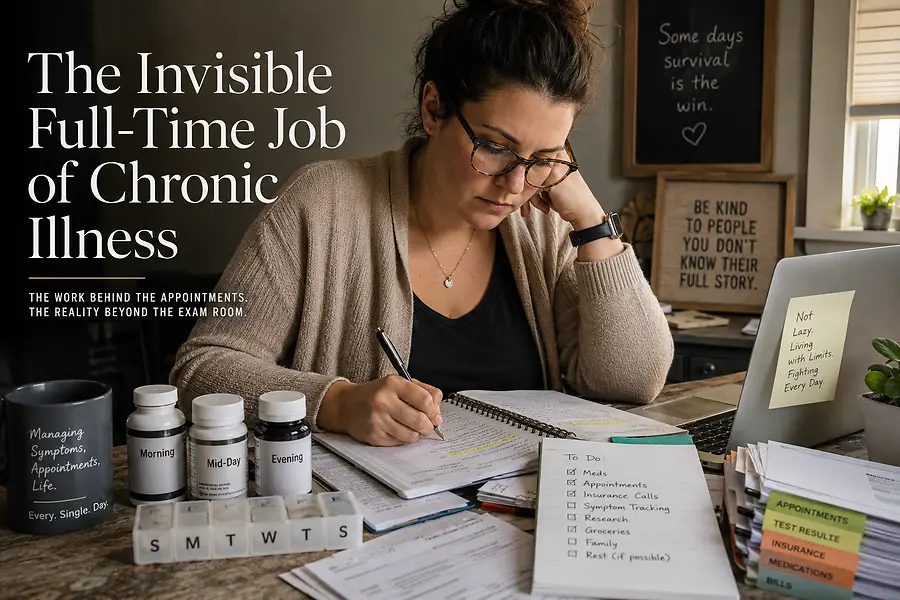
The Invisible Work of Living With Chronic Illness
Most people assume my medical appointments are where I receive healthcare.
The truth is that healthcare is what happens in the hours, days, and weeks between those appointments.
It happens in the middle of the night when pain interrupts sleep. It happens while coordinating specialist visits, managing medications, appealing insurance decisions, researching treatment options, and calculating which necessities can be afforded that month. It happens when symptoms flare unexpectedly and daily plans must be abandoned without warning.
For millions of Americans living with chronic illness, healthcare is not an event. It is a full-time job.
Yet much of this work remains invisible.
As patients, we often arrive at appointments carrying months or years of accumulated data about our own bodies. We know which symptoms have worsened, which medications have failed, which triggers have emerged, and which treatments have provided relief. We have tracked patterns, documented experiences, and learned to recognize subtle changes that may never appear in a laboratory result.
Despite this, the labor required to manage chronic illness is rarely acknowledged within our healthcare system.
Medicine has achieved extraordinary advancements in diagnosing and treating disease. We can sequence genomes, replace joints, transplant organs, and develop therapies once thought impossible. Yet many patients living with complex chronic conditions find themselves confronting a different challenge: navigating a healthcare system designed to treat diseases individually rather than patients holistically.
For those living with multiple chronic conditions, the experience can feel fragmented. One specialist focuses on a particular organ system. Another addresses a separate symptom. A third manages medication interactions. Meanwhile, the patient becomes the central coordinator responsible for connecting the dots among every appointment, recommendation, and treatment plan.
The result is an immense administrative burden that often goes unseen.
Patients become schedulers, record keepers, insurance advocates, pharmacists, researchers, and care coordinators, all while managing their symptoms. This work consumes hours each week and often carries significant emotional and financial consequences.
The impact extends far beyond physical health.
Chronic illness affects careers, relationships, finances, and family life. Parents living with chronic illnesses do not stop being parents when symptoms worsen. Bills continue to arrive regardless of a patient's ability to work. Household responsibilities remain, even when pain levels become unbearable.
Many patients learn to perform wellness because society is often more comfortable with visible resilience than visible suffering.
A patient may smile during an appointment while privately calculating how they will recover from the energy required simply to attend it. They may appear functional while quietly grieving the activities, opportunities, and identities that illness has altered or taken away.
This disconnect creates one of the greatest challenges in chronic illness care: the gap between what providers observe and what patients experience.
Healthcare professionals often see patients for minutes at a time. Patients live with their conditions every hour of every day.
Neither perspective is inherently more valuable than the other. In fact, the best outcomes emerge when both perspectives are treated as essential forms of expertise. Clinicians bring medical knowledge, training, and evidence-based care. Patients bring lived experience, daily observation, and an intimate understanding of how illness affects every aspect of life.
When these perspectives work together, healthcare becomes more effective, compassionate, and patient-centered.
This requires a shift in how we define successful treatment.
Too often, success is measured solely through laboratory values, imaging results, or symptom reduction. While these metrics are important, patients frequently define success differently. Success may mean attending a child's school event, maintaining employment, preparing a family meal, or simply getting out of bed without assistance.
Quality of life matters.
Function matters.
The ability to participate in one's own life matters.
As healthcare continues to evolve, there is an opportunity to better recognize the invisible work patients perform every day. Listening to patient experiences is not merely an act of empathy; it is an essential component of effective care.
The future of medicine will undoubtedly be shaped by technological innovation, scientific discovery, and clinical advancement. But it should also be shaped by a deeper understanding of the realities patients face outside examination rooms.
Because for those living with chronic illness, healthcare does not begin when an appointment starts.
It begins the moment they wake up.
And for many, it never truly ends.