Bridging the Synthetic Gap: McKenna Mimicry and the Evolution of Immunomodulation
How synthetic proteins and aptamers are revolutionizing immunotherapy through deliberate molecular design.

The human immune system is a masterpiece of evolutionary engineering, a sprawling network of cells and signals designed to distinguish “self” from “non-self” with incredible specificity. However, as our understanding of molecular biology has deepened, we have moved beyond merely observing these interactions to actively redesigning them. At the forefront of this shift is the concept of McKenna Mimicry. While classical molecular mimicry often refers to pathogens accidentally imitating host structures to evade detection, McKenna Mimicry represents a deliberate, human-led effort to create synthetic proteins and aptamers that mimic natural ligands to modulate the behavior of the immune system’s most critical players.
The Architect’s Blueprint: Aptamers and Synthetic Proteins
To understand how we can influence the immune system, we must first examine the tools of the trade. Traditionally, monoclonal antibodies were the gold standard for targeting specific cells. However, the landscape is shifting toward smaller, more agile molecules: synthetic proteins and aptamers.
Aptamers are single-stranded DNA or RNA sequences that fold into complex three-dimensional shapes. Because of their unique geometry, they can bind to targets—such as receptors on the surface of a white blood cell—with the same precision as antibodies, but with significantly less “bulk.” When we design these molecules to imitate the shape and charge of natural signaling proteins, we are engaging in McKenna Mimicry. This allows us to “handshake” with a cell, providing it with instructions to either ramp up its defense or stand down.
The Frontline: Modulating Lymphocytes and Macrophages
The primary targets for these synthetic mimics are often the key players of the adaptive and innate immune systems: lymphocytes and macrophages.
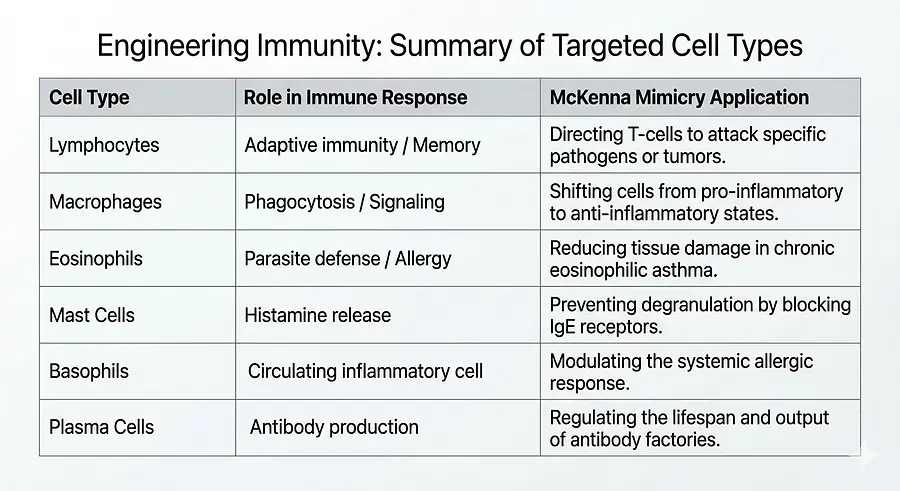
• Lymphocytes (T-cells and B-cells): These are the elite soldiers of the immune system. T-cells, in particular, rely on TCR (T-cell receptor) signaling to determine when to attack. Through McKenna Mimicry, researchers can design synthetic proteins that bind to these receptors, effectively “training” T-cells to recognize tumors that would otherwise remain invisible.
• Macrophages: Known as the “big eaters” of the immune system, macrophages can exist in two states: M1 (pro-inflammatory/aggressive) or M2 (anti-inflammatory/healing). Synthetic aptamers can be used to influence this balance. In cases of chronic inflammation, a McKenna Mimicry approach can send a “calm down” signal, pushing macrophages toward the M2 state to promote tissue repair.
The Allergic Axis: Eosinophils, Mast Cells, and Basophils
While much of immunology focuses on fighting infections or cancer, a significant portion of modern medicine is dedicated to managing overactive immune responses, such as allergies and asthma. This is where modulation of eosinophils, mast cells, and basophils becomes vital.
These cells are the primary drivers of type I hypersensitivity responses. When mast cells or basophils encounter an allergen, they undergo degranulation, releasing a flood of histamine and other inflammatory mediators. This produces the familiar “itch and sneeze” response.
Through McKenna Mimicry, synthetic proteins can be designed to bind to high-affinity IgE receptors on these cells. By “clogging” these receptors with harmless synthetic mimics, allergens are prevented from binding. It is similar to placing a dummy key in a lock so the real key cannot enter. This level of immunomodulation offers a potential pathway for treating severe allergies without the systemic side effects often associated with traditional steroids.
The Antibody Factory: Impacting Plasma Cells
Finally, we must consider plasma cells—the terminally differentiated B-cells responsible for producing thousands of antibodies per second. In autoimmune diseases, plasma cells can become “rogue factories,” producing autoantibodies that attack the body’s own tissues.
McKenna Mimicry provides a way to target these cells specifically. By mimicking survival signals (such as BAFF or APRIL) that plasma cells require to persist in the bone marrow, synthetic aptamers can either support healthy plasma cell populations or, in cases such as multiple myeloma or lupus, deprive them of those signals to reduce harmful antibody production.
Precision Medicine and the Future of Mimicry
The strength of McKenna Mimicry in synthetic protein development lies in its tunability. Unlike broad-spectrum immunosuppressants that weaken the entire immune system, these synthetic mimics can be designed to interact only with specific subsets of cells.
For example, an aptamer can be engineered to activate a specific subtype of T-cell only in the presence of a protein found in a lung tumor. This “conditional logic” represents the holy grail of pharmacology. It moves medicine away from the “sledgehammer” approach of chemotherapy toward a “scalpel” approach, where the body’s own cells are gently guided toward a therapeutic outcome.
Conclusion: The New Language of Immunity
We are entering an era in which biology is becoming a programmable medium. McKenna Mimicry is not merely a scientific curiosity; it represents a fundamental shift in how we communicate with our cells. By creating synthetic proteins that speak the “language” of the immune system, we are opening doors to treatments for cancer, autoimmune disorders, and chronic allergies that were once thought impossible.
As we continue to refine the folding patterns of synthetic proteins and the binding affinities of aptamers, the line between “natural” and “engineered” immunity will continue to blur. The goal remains clear: to harness the power of lymphocytes, macrophages, and the broader immune system to create a future in which the body is its own most effective pharmacy.