Why the Most Expensive Healthcare System in the World Still Underdelivers
How Underinvestment in Primary Care Drives Poor Outcomes and Rising Costs

Abstract
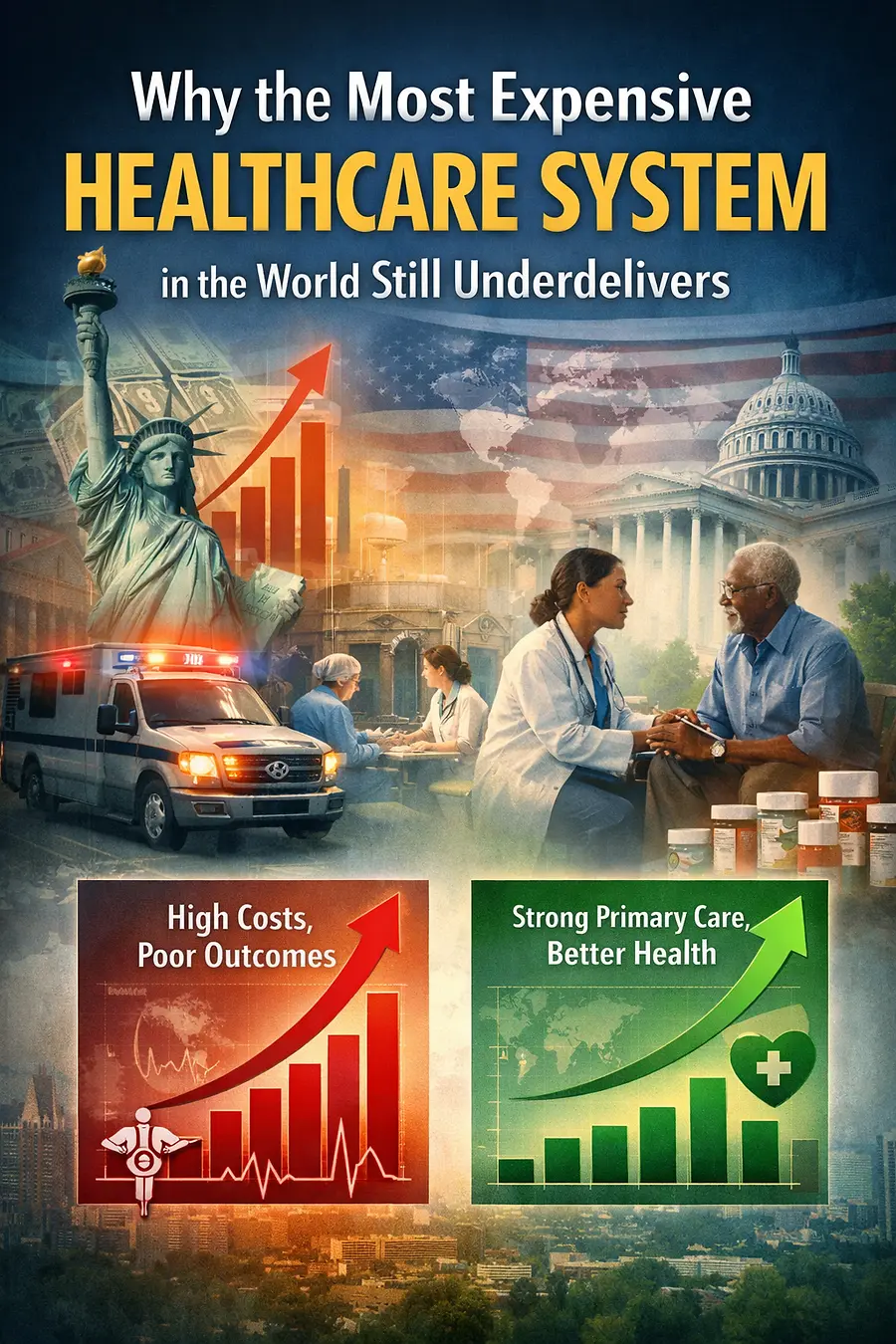
The United States spends more on healthcare than any other nation, yet continues to underperform on key indicators of population health, including life expectancy, chronic disease outcomes, and preventable mortality. This article examines how misaligned spending priorities—particularly the chronic underinvestment in primary care—contribute to rising costs and suboptimal outcomes. Evidence from international comparisons and health systems research suggests that strengthening primary care is essential to improving value, equity, and long-term system performance.
Introduction: The Spending Paradox
The United States devotes a greater share of its gross domestic product to healthcare than any other high-income country, spending nearly twice as much per capita as the average peer nation (OECD, 2023). Despite this investment, the U.S. ranks poorly on measures such as life expectancy, avoidable mortality, and chronic disease burden when compared with other developed health systems (Tikkanen & Abrams, 2020; Commonwealth Fund, 2024).
These outcomes are frequently attributed to patient behavior, insurance design, or demographic complexity. While such factors contribute to overall system performance, they fail to explain why higher spending does not translate into better outcomes. A more fundamental explanation lies in how healthcare resources are allocated. The U.S. system is heavily oriented toward late-stage, high-cost intervention rather than early, longitudinal care. Systems designed to treat disease after it has progressed will predictably cost more and deliver less.
Where the Money Goes
Healthcare spending in the United States is disproportionately concentrated in specialty services, hospital care, and procedural interventions (Hartman et al., 2022). These services are often necessary and lifesaving, yet their dominance reflects payment structures that reward volume and intensity rather than prevention, coordination, or continuity.
Primary care accounts for a relatively small share of total healthcare expenditures—estimated at approximately 5–7%—despite serving as the primary entry point for most patient encounters (Petterson et al., 2018). Limited visit duration, inadequate reimbursement, and high administrative burden constrain the ability of primary care clinicians to deliver comprehensive preventive and chronic disease care. As a result, conditions that could be managed early are often addressed only after they escalate into costly complications.
The Cost of Delayed Care
Underinvestment in primary care contributes directly to delayed diagnosis and suboptimal management of common chronic conditions. Hypertension, diabetes, depression, and substance use disorders frequently progress without adequate early intervention, increasing the risk of hospitalization, disability, and premature mortality (CDC, 2023).
Fragmentation further exacerbates these costs. Patients often receive care from multiple clinicians operating without shared clinical context, leading to duplicated testing, conflicting treatment plans, and medication errors (Starfield, Shi, & Macinko, 2005). Emergency departments increasingly function as default access points for non-emergent care, reflecting failures of access and continuity rather than patient preference. These patterns impose substantial financial costs while undermining patient safety and experience.
How Other High-Performing Systems Differ
International comparisons consistently demonstrate that health systems with stronger primary care infrastructures achieve better outcomes at lower total cost (OECD, 2023; Commonwealth Fund, 2024). These systems invest more heavily in early access, longitudinal clinician-patient relationships, and care coordination across settings.
Importantly, improved performance is not achieved through rationing or reduced quality, but through prioritization of preventive and continuous care. Primary care serves as a stabilizing foundation rather than a gatekeeping barrier, guiding patients efficiently through the healthcare system while minimizing unnecessary utilization.
The Role of Primary Care in Cost Control
A robust body of evidence links strong primary care systems with lower hospitalization rates, reduced emergency department use, and improved chronic disease outcomes (Starfield et al., 2005; Shi, Macinko, & Starfield, 2017). Continuity of care enables clinicians to recognize patterns over time, intervene earlier, and tailor treatment to individual medical and social contexts.
Primary care also plays a central role in preventive services and behavioral health screening—interventions that yield substantial long-term returns but are often undervalued in short-term financial models. When adequately supported, primary care reduces unnecessary utilization without denying care, improving both system efficiency and patient trust.
Why the System Resists Change
Despite consistent evidence, structural barriers continue to limit investment in primary care. Fee-for-service payment models reward procedures over time-intensive care, while cost savings from prevention often accrue outside the budgets of organizations making the initial investment. Workforce shortages, particularly in rural and underserved areas, further restrict access and continuity (AAFP, 2023).
Burnout among primary care clinicians compounds these challenges. Administrative burden, productivity pressure, and inadequate reimbursement threaten the sustainability of primary care practice and discourage trainees from entering the field. Without systemic reform, these pressures risk further weakening the foundation of the healthcare system.
What a Better Investment Strategy Looks Like
Aligning healthcare spending with value requires strengthening primary care workforce pipelines, expanding team-based models, and reforming payment structures to support prevention, coordination, and continuity. Integrating behavioral health services and addressing social determinants of health within primary care settings are critical components of this approach.
Targeted investment in rural and underserved communities, along with reductions in administrative burden, can improve access while enhancing clinician retention. These reforms do not diminish the role of specialty care; rather, they ensure that specialty services are used appropriately and effectively.
Conclusion: Value Comes From the Foundation
The United States healthcare system does not lack innovation or clinical expertise. It lacks alignment between spending and outcomes. A system that prioritizes late-stage intervention while underfunding prevention will continue to generate high costs and poor population health.
Strengthening primary care is not an ideological proposal, but an evidence-based strategy grounded in decades of health services research. If the goal is improved outcomes, greater equity, and sustainable value, the path forward begins where health itself begins: primary care.
References
- American Academy of Family Physicians. (2023). Primary care workforce projections.
- Centers for Disease Control and Prevention. (2023). Chronic disease prevention and health promotion.
- Commonwealth Fund. (2024). Mirror, Mirror 2024: Comparing health system performance across countries.
- Hartman, M., et al. (2022). National health care spending in 2021. Health Affairs, 41(1), 17–25.
- OECD. (2023). Health at a glance 2023: OECD indicators.
- Petterson, S. M., et al. (2018). Investing in primary care. Health Affairs, 37(1), 1–8.
- Shi, L., Macinko, J., & Starfield, B. (2017). Primary care and health systems performance. Milbank Quarterly, 95(2), 299–331.
- Starfield, B., Shi, L., & Macinko, J. (2005). Contribution of primary care to health systems. The Milbank Quarterly, 83(3), 457–502.