Why Primary Care Is the Foundation of a Functional Healthcare System
The Essential Role of Primary Care in Building Healthier, More Efficient Healthcare Systems

Abstract
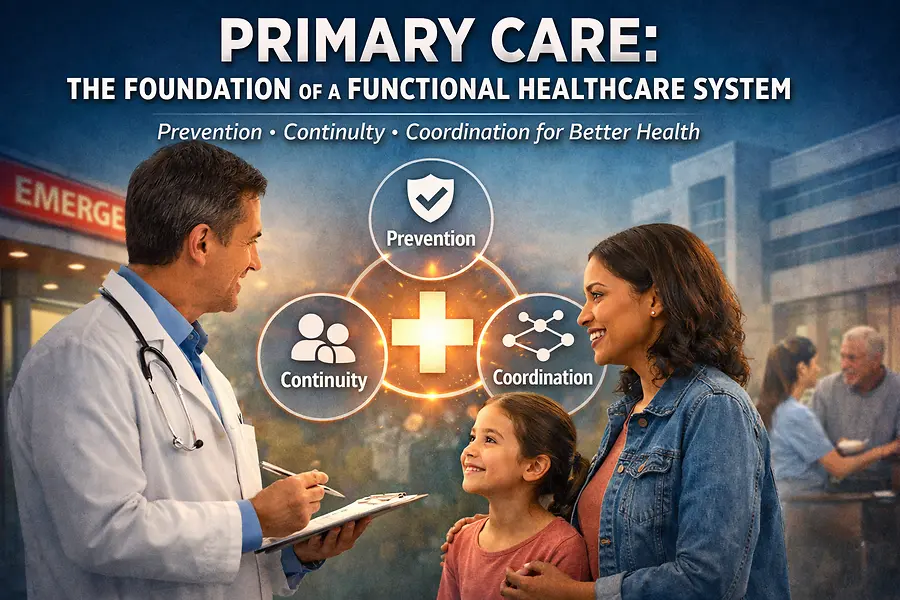
Primary care is the cornerstone of an effective healthcare system, yet it is often undervalued and under-resourced. This article examines how strong primary care improves health outcomes through prevention, continuity, and coordination, while simultaneously reducing healthcare costs and strengthening system-wide performance.
Primary Care as the Entry Point to Healthcare
When people think about healthcare, they often envision hospitals, emergency departments, or highly specialized procedures. While these services are essential, they are not where a healthy healthcare system truly begins. The foundation of any effective and sustainable healthcare system is primary care.
Primary care is where most health concerns first arise and where patients develop long-term relationships with clinicians who understand their medical history, social context, and health goals over time. According to the American Academy of Family Physicians (AAFP), strong primary care is consistently associated with better health outcomes, improved patient experience, and lower overall healthcare costs. Continuity of care enables clinicians to recognize patterns, identify problems early, and intervene before conditions progress into more serious or costly disease.
Prevention: Addressing Problems Before They Escalate
A central function of primary care is prevention. The Centers for Disease Control and Prevention (CDC) emphasizes that routine preventive services—such as vaccinations, blood pressure and diabetes screenings, cancer screenings, and early mental health assessments—play a critical role in reducing preventable illness and premature death.
Many of the most common and costly conditions in the United States are manageable or even avoidable when identified early through regular primary care visits. Preventive care not only improves individual health outcomes but also reduces long-term strain on the healthcare system.
Coordination in an Increasingly Complex System
Beyond prevention, primary care serves as the coordinating center of an increasingly complex healthcare system. Modern medicine involves numerous specialists, diagnostic tests, and treatment pathways, which can quickly become fragmented without a central point of oversight.
The National Academies of Sciences, Engineering, and Medicine have repeatedly highlighted that poor care coordination contributes to duplicated testing, medication errors, and unnecessary healthcare spending. Primary care clinicians play a critical role in helping patients navigate referrals, reconcile medications, and integrate specialist recommendations into a coherent, patient-centered care plan.
System-Wide Benefits of Strong Primary Care
The benefits of strong primary care extend beyond individual patients to the healthcare system as a whole. Research summarized by the Agency for Healthcare Research and Quality (AHRQ) shows that communities with greater access to primary care experience lower rates of avoidable emergency department visits and preventable hospitalizations.
When primary care access is limited or overburdened, patients are more likely to rely on urgent care centers and emergency departments for conditions that could have been managed earlier in outpatient settings—driving up healthcare costs while delivering poorer long-term outcomes.
Trust, Continuity, and Patient Engagement
Access to consistent primary care also strengthens trust and patient engagement. Evidence summarized by the World Health Organization (WHO) indicates that individuals who maintain an ongoing relationship with a primary care clinician are more likely to adhere to treatment recommendations, communicate openly about sensitive concerns, and receive timely follow-up care.
This continuity is particularly important for managing chronic disease, mental health conditions, and complex life transitions, where episodic or one-time care is rarely sufficient.
Investing in the Foundation
Despite its proven value, primary care remains under-resourced relative to its impact. Strengthening primary care is not merely a workforce issue—it is a patient safety imperative, a cost-control strategy, and a public health investment.
A healthcare system built on strong primary care is proactive rather than reactive. It prioritizes prevention over crisis, coordination over fragmentation, and relationships over transactions. When primary care is adequately supported, patients experience better outcomes, clinicians practice more effectively, and the healthcare system functions as it was intended.