Beyond AI: Why Standardizing Healthcare Systems Doesn't Standardize Decisions
Why standardizing data alone cannot standardize how clinicians decide.

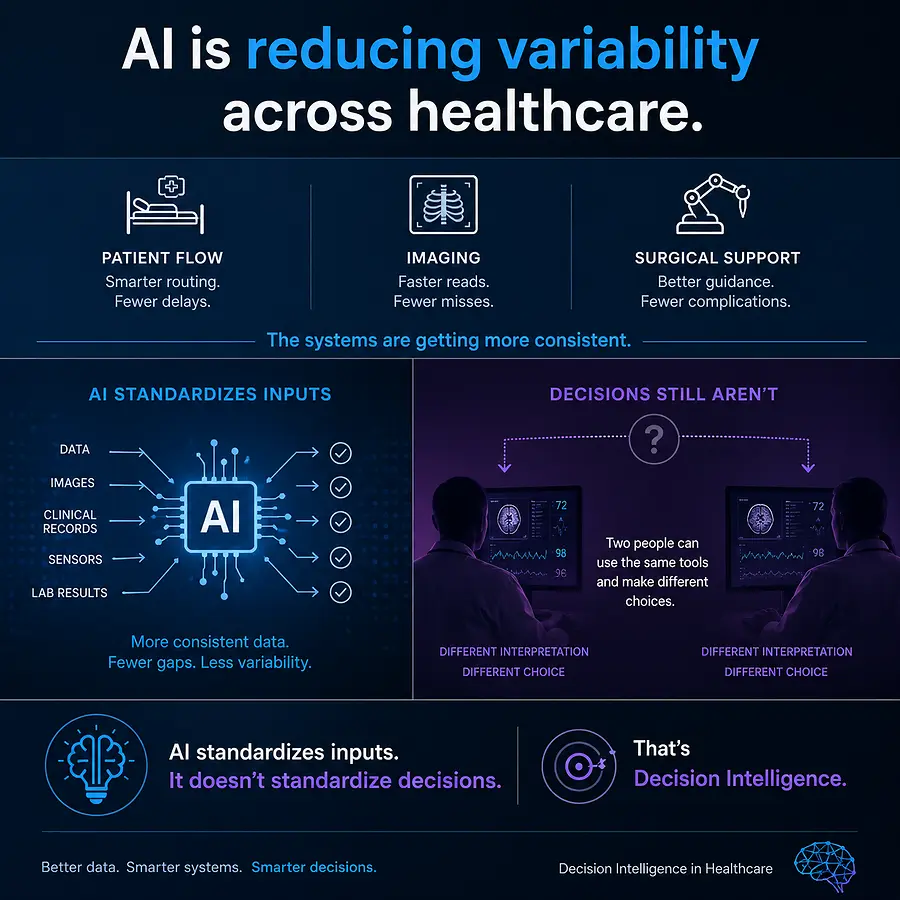
AI Can Standardize What Enters the System
It Cannot Standardize What Happens Next
Healthcare systems are becoming increasingly standardized.
Electronic health records are optimized. Workflows are refined. AI is now structuring inputs across imaging, documentation, triage, and administrative processes.
Yet one layer remains fundamentally inconsistent:
Decision-making.
Two clinicians can operate within the same system, follow identical workflows, and access the same data—yet arrive at different conclusions.
This variability is not noise. It is structure.
Across healthcare environments, distinct decision patterns emerge:
- Engineers often delay escalation while continuing to troubleshoot
- Clinical teams escalate earlier through protocol-driven thresholds
- Operational roles prioritize rapid action to restore continuity
- Commercial functions validate decisions through alignment and consensus
Each role reflects a different logic for navigating uncertainty.
In other words, the system does not just process work—it shapes how decisions are made under pressure.
The Limit of Standardization
AI is reducing variability in data.
It is improving consistency in documentation, interpretation support, and information flow.
But it does not standardize interpretation.
It does not define escalation thresholds.
It does not resolve ambiguity in real time.
That gap remains human.
And that is where variability persists.
Where Variability Actually Lives
In most optimization efforts, variability is treated as a system problem—something to be engineered out through better tools, clearer protocols, or tighter workflows.
But variability does not originate in the system.
It originates in the decision.
How individuals interpret incomplete information.
How they weigh risk under uncertainty.
How they prioritize speed versus accuracy.
How they escalate—or choose not to.
These are not technical variables. They are cognitive ones.
Improving Healthcare Requires a Second Layer of Focus
Improving healthcare performance is no longer just about optimizing systems of record or automating administrative burden.
It requires understanding systems of decision.
Because two people can operate in the same environment and still produce entirely different outcomes—not because the system failed, but because interpretation diverged.
The Real Frontier
AI will continue to reduce variability in what enters healthcare systems.
But the most consequential variability will remain where it has always been:
In how humans decide what happens next.
And until that layer is understood as clearly as the systems around it, optimization will remain incomplete.
Because the system may be standardized.
But decision-making never is.