Autism Awareness Month Is Not Enough
It’s Time for Systems That Actually Work

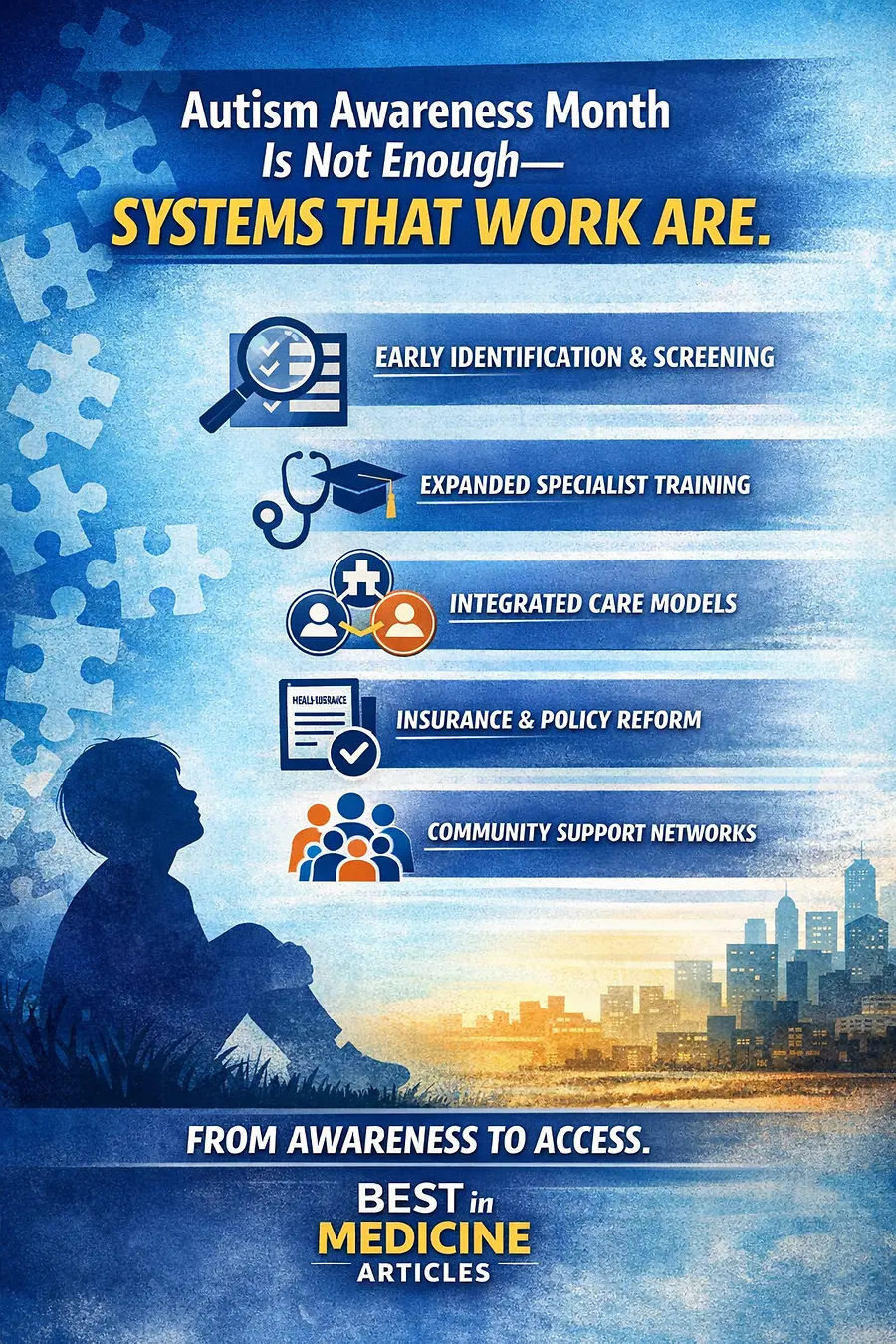
April is Autism Awareness Month. You’ll see the posts, the hashtags, and the campaigns encouraging understanding and acceptance.
Awareness matters. But awareness alone doesn’t change outcomes.
For millions of individuals and families, autism is not a once-a-year conversation. It’s a daily reality shaped by access to care, school systems, social support, and policy decisions that often fall short of what’s needed.
If we’re serious about this, we need to move beyond awareness—and start fixing the systems.
The Gap Between Awareness and Access
Autism spectrum disorder (ASD) affects approximately 1 in 36 children in the United States, a number that has steadily increased as screening and recognition improve (CDC, 2023).
But identification is only the beginning.
Across the country, families face:
- Months- to years-long waitlists for diagnostic evaluations
- Limited access to behavioral therapy (including ABA in some regions)
- Shortages of developmental pediatricians and child psychiatrists
- Insurance barriers that delay or restrict care
In rural communities, these gaps are even wider.
Awareness doesn’t shorten a waitlist. Systems do.
The Reality Families Live Every Day
For many families, a diagnosis is just the entry point into a long and often fragmented system.
Parents become case managers.
Children navigate environments not designed for them.
Progress depends as much on geography and resources as it does on need.
There is also a persistent misunderstanding of autism itself.
It’s not one experience—it’s a spectrum.
Some individuals require substantial daily support. Others live independently but still face challenges that are invisible to most people—sensory overload, communication differences, or social barriers that accumulate over time.
Too often, public perception lags behind reality.
The Harm of Misinformation
Despite decades of research, misinformation continues to shape public conversations.
Myths around causation—whether tied to vaccines, medications, or other external factors—persist despite overwhelming evidence to the contrary (Hviid et al., Ann Intern Med, 2019).
This isn’t just a scientific issue; it’s a trust issue.
When misinformation spreads, it delays care, increases stigma, and shifts attention away from what actually helps: early identification, evidence-based intervention, and long-term support.
What Actually Moves the Needle
If we want to improve outcomes, the focus needs to shift toward systems-level solutions:
1. Early Identification and Screening
Routine developmental screening in primary care settings needs to be consistent, accessible, and acted upon quickly.
2. Workforce Expansion
We do not have enough specialists. Expanding training pathways—and empowering primary care to play a larger role—is essential.
3. Integrated Care Models
Autism care should not exist in silos. Medical, behavioral, and educational systems need to function as a coordinated network.
4. Insurance and Policy Reform
Coverage should reflect evidence-based care, not administrative barriers. Families shouldn’t have to fight for services that are already the standard of care.
5. Community-Based Support
Support doesn’t end in the clinic. Schools, workplaces, and communities all play a role in long-term outcomes.
The Role of Family Medicine
This is where primary care—and especially family medicine—matters.
Family physicians are often the first point of contact. They are in a position to:
- Recognize early signs
- Initiate evaluations
- Coordinate care across systems
- Support families longitudinally
In underserved and rural areas, they may be the only consistent access point.
If we strengthen primary care, we strengthen the entire system around autism.
Moving Forward
Awareness is a starting point. It opens the door.
But systems determine what happens next.
If we want to make Autism Awareness Month meaningful, we should measure success not by how many people post, but by how many families can actually access care when they need it.
That’s the difference between acknowledging a problem and solving one.
References
CDC. Autism Spectrum Disorder Data & Statistics (2023)
Hviid A, et al. Measles, Mumps, Rubella Vaccination and Autism. Ann Intern Med. 2019
- American Academy of Pediatrics. Autism Clinical Guidelines