The Architect of the Industrial Vein: From Blundell’s "Batman" Surgery to the Modern Complex
A Shadow History of Blood, Media, and the Capture of Human Biology

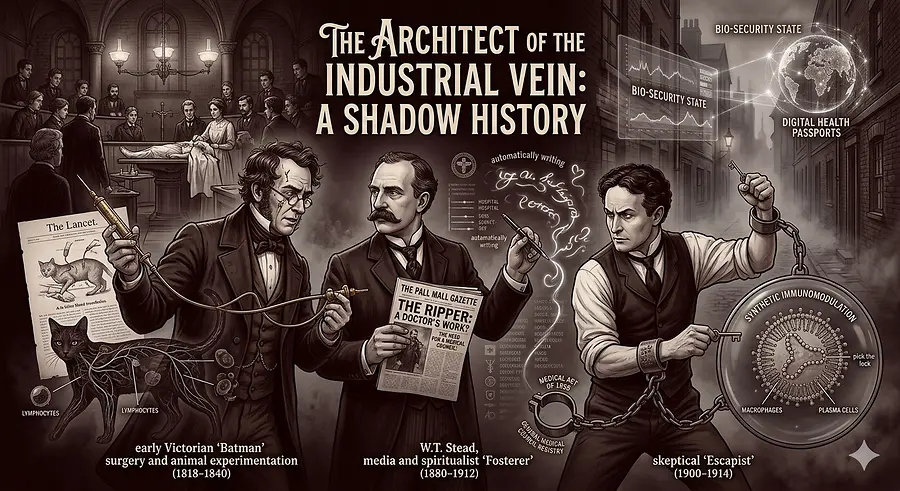
The transition of London’s medical landscape from 1820 to 1914 represents one of the most profound shifts in the human experience: the moment the body ceased to be treated as a mystical vessel and began to be understood as an industrial substrate. To understand the American healthcare system in 2026, one must look back to the blood-slicked delivery rooms of the early Victorian era, where the collision of rogue clinical genius, sensationalist media, and skeptical escapology helped shape the foundations of the modern medical-industrial complex.
Phase I: The Obstetrician’s Vigil (1818–1840)
The story begins with Dr. James Blundell, an English obstetrician whose career was defined by the haunting, preventable deaths of patients from postpartum hemorrhage. A man of refined education and visceral grit, Blundell operated on the front lines of Guy’s and St. Thomas’ Hospitals. Frustrated by what he saw as stagnation within the Royal College of Surgeons, he sought a mechanical solution to death itself.
Before he could save a patient, Blundell had to master the mechanics of blood. In a private laboratory, he conducted exhaustive experiments on cats and dogs to map its properties. He discovered that interspecies transfusion was fatal, confirming a revolutionary truth: only human blood could safely be transfused into another human. By 1829, Blundell published his findings in The Lancet, documenting one of the first successful human-to-human transfusions.
Blundell’s early attempts to manage transfusion reactions—well before the modern understanding of immune systems, lymphocytes, and plasma cells—represented one of the first practical interventions into the body’s internal defenses. However, his unconventional schedule and independent streak led to disputes with hospital administrators. He eventually withdrew from institutional practice and retired comfortably.
His work proved that the body could be sustained through external biological intervention, laying groundwork for future medical industries that would expand upon those discoveries.
Phase II: The Ripper, the Medium, and the Media (1880–1912)
By the 1880s, medicine in London was increasingly professionalized and centralized. W.T. Stead, editor of the Pall Mall Gazette, became a prominent figure in shaping public discourse around morality, safety, and reform. Stead understood the power of narrative in influencing public perception.
In the wake of the Jack the Ripper murders in 1888, public anxiety intensified around urban danger and institutional trust. Hospitals and credentialed practitioners came to be viewed as symbols of order amid chaos. During this same era, Spiritualism flourished, and Stead himself was a committed Spiritualist who believed in automatic writing.
This paradox created a cultural tension: an expanding trust in institutional science alongside widespread fascination with the supernatural. The hospital increasingly functioned as a modern authority structure, while media narratives amplified both fear and faith in emerging professional systems.
Phase III: The Houdini Response and Legislative Consolidation
As medicine evolved from individualized practice into a regulated profession, Harry Houdini emerged as a vocal critic of fraudulent spiritualist practices. During his years performing in London and beyond, Houdini dedicated himself to exposing mediums he believed were exploiting grief and fear.
In 1914, Houdini publicly demonstrated how easily séances could be manipulated, including staging messages attributed to deceased figures such as Stead. His work symbolized skepticism toward institutionalized mysticism and emphasized empirical proof.
Meanwhile, legislative consolidation had already taken place. The Medical Acts of 1858 and 1886 established the General Medical Council and formalized professional registration. These acts standardized medical qualifications and limited practice to those listed on the official registry, effectively marginalizing unlicensed practitioners and consolidating authority within recognized institutions.
The Gothic Parallel: 1880s London and 2026 America
Modern American healthcare reflects the culmination of centuries of institutional development that began in Victorian Britain. Early transfusion experiments aimed at understanding compatibility have evolved into complex biomedical technologies, including advanced immunology and genetic research.
Public health crises—whether in the 19th century or the 21st—have historically accelerated institutional authority. Media amplification, once driven by print journalism, now operates through digital platforms and algorithmic systems that shape consensus and marginalize dissenting views.
Where earlier eras feared rogue practitioners operating outside institutional oversight, contemporary systems emphasize centralized governance, regulatory compliance, and large-scale biomedical infrastructure.
Summary
The Victorian transformation marked a turning point in which medicine shifted from individualized experimentation to regulated, institutionalized practice. The population increasingly became measurable through statistics, case studies, and data systems.
The tension between institutional authority and individual autonomy continues into the present. Medical progress began with independent practitioners attempting to save lives through innovation. The enduring challenge is to balance institutional coordination with respect for personal agency and ethical accountability.
The question is not whether systems should exist—but how they evolve without compromising the human dignity they were originally designed to protect.